Duplication
When everyone is responsible, nobody is responsible

A budget that cannot pay itself back
The 2026-27 Commonwealth Budget records an underlying cash deficit of $31.5 billion. It is the eighth deficit in a row. The budget projects another four. The forward estimates show no return to surplus until 2034-35, and that distant surplus depends on a decade of forecasts in which nothing goes wrong.
Gross debt passes $1 trillion this year. It reaches roughly $1.19 trillion by 2028-29 and keeps climbing. The budget contains no plan to repay any of it. The published strategy is to let the debt shrink as a share of the economy through nominal growth. The plan, stated plainly, is to grow and inflate the debt into relative insignificance rather than pay it down. There is no year, anywhere on the horizon, in which the Commonwealth returns a dollar of principal.
The interest bill tells the story most clearly. In 2026-27 the Commonwealth will pay $29.6 billion to service its debt. By 2029-30 that figure reaches $42.3 billion. Interest is the fastest growing major payment in the budget, rising at about 8.8 per cent a year. By the end of the forward estimates the annual interest bill exceeds the entire defence acquisition program. The country will soon spend more servicing yesterday’s borrowing than equipping tomorrow’s military.
The shape of a debt trap
Set the interest bill beside what the budget actually builds. Net capital investment by the Commonwealth, the money spent creating assets that generate a future return, falls to $9.3 billion by 2029-30. Strip out defence and the figure turns negative. The Commonwealth is disinvesting from everything except the military.
The ratio is roughly four and a half to one. For every dollar the Commonwealth invests in productive assets outside defence, it pays more than four dollars in interest on debt already incurred. This is the shape of a debt trap. Borrowing funds consumption, the consumption produces no return, the debt compounds, and the interest crowds out the very investment that might have generated the growth to service it.
A household in this position would recognise it at once. The credit card minimum payment has grown larger than the grocery budget, and the response is to borrow again for groceries. The arithmetic only ends one way.
The usual response to these numbers divides along a familiar line. One side says cut spending. The other says raise tax. Both accept the same premise, that the problem is the total.
The premise is incomplete. The deficit is real and the total matters, but the more useful question is not how much the Commonwealth spends. It is where the Commonwealth spends, and through what machinery. A government can run a department, employ thousands of officials and move tens of billions of dollars without delivering a single service, because the service is delivered by someone else. When that happens at scale, the spending buys administration rather than outcomes, and the administration duplicates an apparatus that already exists at another level of government.
That is the condition Australia is in. To see it requires going back to the document that is supposed to govern who does what.
The Constitution
The Australian Constitution sets out, in section 51, the matters on which the Commonwealth Parliament may make laws. The list is finite. It includes:
● defence
● external affairs
● trade and commerce with other countries
● currency
● immigration
● postal services
● marriage
● and a defined set of others
Section 107 preserves to the states every power not handed to the Commonwealth. Health, education, the environment, land, water, housing and policing appear nowhere in the Commonwealth’s list. They are state responsibilities, and they have been since 1901.
How does a government with no constitutional power over schools or hospitals come to run a Department of Education and a Department of Health, Disability and Ageing, each spending tens of billions of dollars a year?
The answer is section 96, which lets the Commonwealth grant money to the states on whatever terms and conditions it chooses. The conditions are the mechanism. They allow a government with no authority over a matter to acquire practical control of it by attaching strings to the money. This is central planning. It rests on the idea that planners in Canberra know better than the states how to run a school, a hospital or a river, and they do not.
The leverage came from a single wartime decision. In 1942 the Commonwealth took over income taxation from the states, a move the High Court upheld. The states never got it back. The result is the vertical fiscal imbalance that defines Australian government to this day. The Commonwealth raises around 80 per cent of all tax revenue while the states carry most of the responsibility for delivering services. The states cannot fund their own constitutional functions from their own revenue, so they depend on transfers from Canberra, and the transfers come with conditions. A 1946 referendum then added section 51(xxiiiA), the power to provide a defined list of social benefits directly, which is the one place the Commonwealth was expressly granted a welfare role.
Hold those two facts together. The Commonwealth has explicit authority to pay benefits to individuals. It has no authority to run schools, hospitals or environmental regulation. The first it does directly and cleanly. The second it does through conditional grants and a duplicate bureaucracy. The difference between those two models is the difference between a budget that works and a budget that does not.
The 1946 power is worth reading closely, because it is almost entirely a cash power. It lets the Commonwealth pay pensions, family payments and unemployment and sickness benefits to individuals. It says nothing about delivering services. The states still deliver the welfare services: child protection, public and community housing, homelessness services, disability services outside the NDIS, community and family support, and pensioner concessions. The clean split is cash to the Commonwealth and services to the states, and where that line has held it has worked. The trouble begins wherever the Commonwealth moved from writing cheques to delivering or directing services.
The test that sorts good spending from bad
There is a simple diagnostic that separates Commonwealth spending that is constitutionally proper and efficiently run from spending that is neither. Measure the administrative overlay against the money administered. Ask how many cents of bureaucracy it takes to move each dollar to its destination, and ask whether a state government is already doing the same job.

The Department of Social Services administers the age pension, the disability support pension, family payments, carer payments, paid parental leave and unemployment benefits. In 2026-27 this amounts to about $163 billion in income transfers to individuals. The departmental overlay that runs it is roughly $168 million. That is around one tenth of one per cent. The payments are legislated, the eligibility rules are clear, the delivery is handled through existing infrastructure, and no state government runs a competing pension system. There is no duplication, the accountability is clear, and the overlay is tiny. The Commonwealth sets the rate, pays the money and answers to voters for the result. This is what a properly assigned federal function looks like.
The Department of Health, Disability and Ageing administers about $172 billion in 2026-27, covering Medicare, the Pharmaceutical Benefits Scheme, the private health insurance rebate, aged care and hospital funding. The departmental overlay is roughly $1.7 billion, around 0.84 per cent of the money it moves. That is eight times the Social Services ratio. The department runs no hospital, employs no doctor and dispenses no medicine. The hospitals are run by the states. On top of the department sit at least eleven separate agencies, each its own bureaucracy. The Aged Care Quality and Safety Commission regulates facilities the states operate. The Independent Health and Aged Care Pricing Authority sets prices for hospitals the states run. The Australian Institute of Health and Welfare collects statistics the state health departments also collect.
The eight-fold difference in overlay is not an accident. It is the cost of operating in someone else’s constitutional territory. Where the Commonwealth makes clean legislated transfers in its own sphere, the overhead is negligible. Where it runs programs in the states’ sphere, it must build a policy and compliance apparatus that mirrors the one the states already maintain, and the overhead balloons.
Departments that run nothing
The pattern repeats across every portfolio that touches a state function, and the budget papers describe it in the Commonwealth’s own words.
The Department of Education has a departmental overlay of about $429 million and runs no school. Its program tables are a list of transfers. Government schools national support is $12,970 million, described in the department’s own words as supplementary financial assistance to state and territory governments. Non-government schools national support is $21,437 million. The child care subsidy is $16,917 million, paid to families. Core funding for higher education teaching is $9,233 million, paid to universities. Every dollar is a payment to someone else who delivers the service. The department is a conduit with a $429 million running cost.
The Department of Climate Change, Energy, the Environment and Water runs a departmental overlay of about $1.2 billion across four functions. One of them, the Antarctic program at around $359 million, is a genuine Commonwealth responsibility under the external affairs power, and it should stay. The rest administers grants for work on land and water the states are responsible for. The Natural Heritage Trust is $220.6 million. The Reef Trust is $151.8 million. The environmental water special account is $402.9 million. The Murray-Darling Basin Authority receives $53.7 million to coordinate an agreement between states. The department does not own the land or manage the rivers. It funds others to do so.
The clearest admission sits in the budget itself. The department runs a measure called Faster Environmental Approvals with the States and Territories, funded at $65.6 million over four years, whose stated purpose is to reduce duplication between Commonwealth and state environmental approvals. The Commonwealth is spending $65.6 million to partially mitigate a duplication it created and could remove entirely by vacating a field the Constitution never gave it. The duplication is not a theory. It is a line item, and the government is paying to manage it rather than to end it.
Housing is the most absurd case, even though it is not the largest. The Commonwealth has no constitutional role in housing. Land use, zoning, development approval and building regulation are administered by local government under state planning law. The Commonwealth owns none of it and controls none of it. Its response to a housing shortage, a shortage driven substantially by the high immigration that the Commonwealth alone controls, is to spend through Housing Australia. The construction funding adds no house, because it adds no builder, no tradesperson and no parcel of zoned land. It enters a building market already at capacity and competes for the same firms and workers who are already building, which raises the price of construction rather than the quantity of it. The social and community housing it finances duplicates the state housing authorities that exist to do exactly that. The mortgages it underwrites plant a federal contingent liability in a property market the Commonwealth cannot supply into. Every arm of it operates in territory the Constitution assigns to the states and to local government. The Commonwealth created the demand and holds none of the supply levers, and it spends regardless, on a $50 million administrative overlay, to appear to act in a field it does not control.
When everyone is responsible, no one is!
Duplication does more than waste money. It destroys accountability, because responsibility for an outcome is split across two levels of government and several agencies, so that no electorate can identify who to punish when the outcome is bad. The clearest illustration is the National Disability Insurance Scheme.
The NDIS is funded by the Commonwealth and the states jointly. In 2026-27 the scheme’s total resourcing is about $59.5 billion, of which the states contribute around $13.1 billion. Here is the part that should give every taxpayer pause. The states raise almost none of their own income tax, because the Commonwealth took it in 1942. The money the states contribute to the NDIS is, in substance, money the Commonwealth gave them in the first place. The states hand back funds that originated in Canberra, so that a Commonwealth agency can run a service the states used to deliver, funded by tax the Commonwealth raised, with neither government accountable for the result. The circularity is not an accounting quirk. It is the mechanism that destroys accountability, because money with no clear owner is money with no discipline. The scheme grew from an estimated $22 billion at maturity to nearly $60 billion and rising, precisely because no single government faces the full political cost of controlling it.[1]
Disability support is administered four separate ways at the federal level alone. The disability support pension sits in Social Services at $26.3 billion. Disability employment services sit there too at $1.3 billion. The National Disability Insurance Agency sits in the Health portfolio. The NDIS Quality and Safeguards Commission is a separate regulator again. One cohort, four federal structures, two portfolios, before the states and their own residual services are counted. The scheme’s own integrity chief told a parliamentary inquiry that leakage runs at about 8.3 per cent of payments, roughly $3.7 billion a year, against a whole-of-government fraud norm of under one per cent. A former head of the Australian Criminal Intelligence Commission, since appointed to police the scheme, has estimated the figure could reach 20 per cent. The same inquiry heard that the courts would be overwhelmed if every case were prosecuted. A scheme whose fraud volume would break the legal system if pursued is not a scheme with a problem at the margin.
The sharpest instance
The same disease appears in its politically sharpest form in Indigenous affairs, and it is worth describing coldly, because the heat that usually surrounds the subject is what has protected the spending from scrutiny.
Most spending directed at Indigenous Australians is not separate at all. The Productivity Commission’s most recent expenditure report found that around 64 per cent of it is simply the Indigenous share of mainstream services, Medicare, schools and hospitals that every Australian uses. That portion is exactly as it should be. Indigenous Australians are Australians and use universal services like everyone else. Around 18 per cent, in the order of $6 billion when the report was compiled and perhaps $8 to $9 billion now across all governments, is Indigenous-specific spending administered through a dedicated apparatus.
That apparatus is the duplication. In the Prime Minister and Cabinet portfolio alone, the National Indigenous Australians Agency administers about $3 billion through a departmental overlay of roughly $308 million, alongside five further dedicated bodies: Indigenous Business Australia, the Indigenous Land and Sea Corporation, Aboriginal Hostels Limited, the Torres Strait Regional Authority and the Australian Institute of Aboriginal and Torres Strait Islander Studies. The agency’s overlay-to-grant ratio is around 11 per cent, more than a hundred times the Social Services figure. The agency’s own program description for Children and Schooling states that it works to ensure mainstream agencies, meaning state and territory governments, support First Nations education. The Commonwealth funds a federal agency to influence how state schools, which the Commonwealth does not run, educate one group of children.
The results do not justify the apparatus. The Productivity Commission, the government’s own independent umpire, reported in 2025 that only four of nineteen Closing the Gap targets are on track, that four are actively worsening, and that adult imprisonment has risen 30 per cent since 2019. Even the four counted as successes are thin. One measures hectares of land under recognised title rather than any change in living standards, and another counts employment that includes positions inside the apparatus itself. After decades of effort and a separate apparatus costing billions, that is the record. A separate delivery model, carrying heavy overhead and split accountability, has failed on its own measures. Folding recipients into the universal systems that serve every other Australian would be both fairer and more accountable. Readers can draw their own conclusions about where the money went.
The same disease, the most expensive instance
Electricity is a state responsibility, and for most of the twentieth century the states ran it directly. State electricity commissions generated the power, built the transmission and sold electricity to citizens. Australia had among the cheapest electricity in the developed world, on the back of abundant coal and integrated public utilities whose mandate was reliable power at low cost to their constituents.
In the 1990s the states agreed, through national competition reforms, to create a single wholesale market across the eastern states, the National Electricity Market, or NEM. The market was governed by a new set of bodies that did not exist before. The Australian Energy Market Operator, AEMO, dispatches the system. The Australian Energy Market Commission, the AEMC, writes the rules. The Australian Energy Regulator, the AER, enforces them and sets network revenues. Above them sits the Climate Change Authority, an advisory body whose emissions advice shapes the policy the energy minister sets, which in turn reshapes the rules the operator must follow. These bodies are creatures of a cooperative scheme the states themselves built, so the argument against them is not constitutional. It is the harder and more damning argument of results. An entire apparatus now exists where none was needed before, and the states already ran the system without it.
The market was sold on one central promise, that competition would deliver lower prices. Judged against its own founding objective, it has failed. Electricity prices have risen about 181 per cent since 2000, and have risen relative to comparable economies. An institution should be measured against the promise on which it was built, and against that promise the verdict is plain.
The deeper failure is accountability. Under the old model, a state government that delivered expensive or unreliable power could be thrown out at a state election. The minister wore the result. The national market dissolved that line of responsibility. Decisions are now spread across the market operator, the rule-maker, the regulator, the Commonwealth energy minister and the state ministers, so that no electorate can punish any of them for the outcome. The causes of the price rises are contested, and they do not need to be settled here. The structure is so tangled that the causes are argued in perpetuity by the players and the vested interests, each pointing to the one beside it. A state premier can point at a state minister, who can point at the market operator, who can point at the rules, who can point at the Commonwealth. A whole micro-industry of analysis and advocacy now exists to conduct that argument, and it exists only because the ambiguity does. Whatever the cause, the decisions were made inside a structure where no voter could hold anyone to account, and a state-run system would at least have allowed constituents to choose differently and to remove a government that chose badly.
Queensland is the live counter-example. It kept its state-owned generators and network businesses, Stanwell, CS Energy, Powerlink and Energy Queensland, through the entire period. The state generates more power than it consumes and exports to New South Wales. It is also still tethered to the national market and pays the traded price. A state that generates and transmits its own power through public utilities is the clearest demonstration that the federal apparatus is not required, at least not in Queensland.
The gas story compounds the point. East coast gas now trades around $12.50 a gigajoule, against $2 to $3 in the United States, and the scarcity is self-inflicted. The export industry was built with foreign state-owned equity for the specific purpose of export. The decision by New South Wales and Victoria not to develop their own gas for their own consumers, and the absence of any reservation policy of the kind Western Australia adopted, created the shortage. The gas belongs to the Crown in right of the state. Choosing to pay globally traded prices for a commodity the state owns was a policy choice, and a different choice was available.
Then there is the cost the public never sees in the budget. AEMO is a corporate body that sits outside the budget entirely. It recovers about $734.8 million a year from market participants, and those charges are passed through to electricity and gas bills. The coordination layer alone, the parts that did not exist before the national market, runs to about $403.7 million a year. The federal energy regulator costs around $117 million, the Clean Energy Regulator $168 million and the Climate Change Authority $14 million. The whole governance apparatus of the national market costs in the order of half a billion dollars a year, borne by consumers one way or another, for a market that failed at its single founding purpose.
The sharpest item is the Capacity Investment Scheme. It is the Commonwealth’s flagship energy intervention, underwriting 40 gigawatts of new generation and storage and supporting about $73 billion of investment through contracts that run up to fifteen years. The scheme works by guaranteeing a generator’s revenue. The Commonwealth pays 90 per cent of any shortfall below an agreed floor and claws back half of any gain above a ceiling. The public carries the downside of a fifteen-year bet on electricity prices and surrenders most of the upside, while the asset stays in private hands throughout, and much of the generation sector is foreign owned. This is the socialisation of risk and the privatisation of reward, often for foreign interests. It is not a market at all.
It is also the purest accountability failure in the budget. The scheme’s expense line is marked nfp, not for publication, in every year of the forward estimates. The cost is suppressed on the ground that publishing it would reveal the Commonwealth’s negotiating position. The exposure is genuinely open-ended, because it depends on where electricity prices land over fifteen years, which means the public is the counterparty to a price bet whose cost no parliament specifically approved and no citizen can size. The old state utility put its power stations on a balance sheet the state parliament voted on. The scheme that replaced that model hides its central number from the people who carry the risk.
Snowy 2.0 is the same failure in its most expensive single dose. Announced by the Turnbull government in 2017 at about $2 billion, to deliver power by 2021, it was revised to $6 billion after a feasibility study and then to $12 billion at a 2023 reset. It has now breached the $12 billion budget again, and a line-by-line cost reassessment is underway, with the company declining to name a figure until it is complete. Independent experts estimate the full cost, including interest and the dedicated transmission the project needs to connect, at around $42 billion, a figure the company disputes. The construction contract was struck on a cost-plus basis, so the Commonwealth covers the foreign contractor’s cost inflation while paying an agreed profit margin on top, the same socialisation of risk that runs through the rest of the scheme. The project is Commonwealth owned, intervening in generation and storage, which is a state function, and it was announced as a political centrepiece without a business case. It is six times over its announced cost, seven years late, and analysts now openly question whether finishing it is even justified. Not one minister has lost office over it, because the accountability is diffused exactly as the rest of this apparatus is.
The point that ties it back to the start of this article is the borrowing. The most recent budget, the one under examination here, accelerated a loan payment and added a $975 million equity injection, on top of $4.35 billion in loans across the next two financial years. The Commonwealth is in structural deficit. Every dollar it tips into this project is borrowed. A government that has to borrow every dollar it spends should not be committing fresh billions to a contested megaproject whose completion is in doubt. At a minimum the further funding should stop until the budget is in surplus and the debt is falling. The interest on borrowing exactly like this is the fastest-growing line in the budget.
The structural prize
The federal departmental overlay, the bureaucracy that disappears when these functions return to the states, can be counted from the budget papers. It comes to about $4.6 billion a year across roughly 18,900 staff. The table below sets it out.
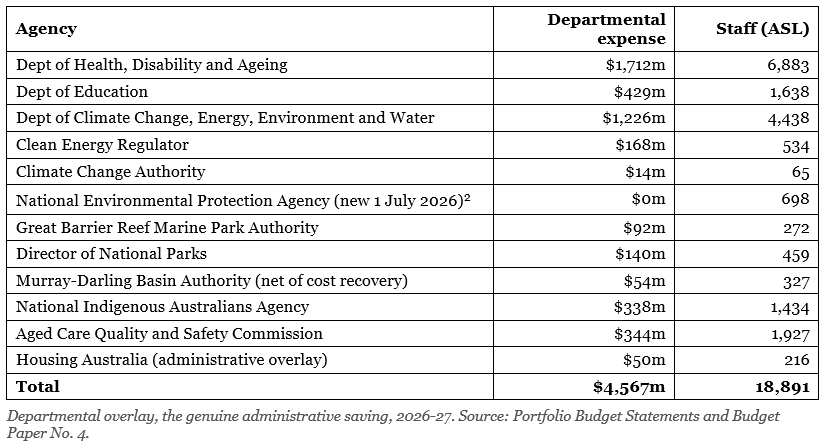
That $4.6 billion is the part that can be banked. It is also the visible tip of a far larger structure.
Commonwealth payments to the states for specific purposes total about $97.5 billion in 2026-27. These are the section 96 tied grants: the national health reform funding, the schools funding, the skills agreement, the housing and homelessness funding and the rest. The flow itself is not waste, because it pays for real services that the states deliver. The waste is the duplicated compliance machinery that the conditions require at both levels of government. Every condition the Commonwealth attaches needs a Commonwealth bureaucracy to design and monitor it, and a matching state bureaucracy to report against it. Two sets of officials administer one set of services. Untie the grants and both layers can shed the compliance overhead that exists only to service the conditions.
This is the larger prize, and it cannot be sized precisely from the budget papers, because the duplicated compliance cost is buried inside dozens of agencies at two levels of government. It is structurally the biggest saving available, and it is the reform the constitutional argument actually points toward.
The fix
The money for state matters should go to the states, and the states should be left to run their own affairs.
Abolish the federal departments and agencies that duplicate state functions, and fold their funding into transfers to the states. The Department of Education does not need to exist for the Commonwealth to fund schools. The Department of Health does not need to run to fund hospitals. The funding continues. The federal apparatus that administers it does not.
Then remove the conditions. Stop the central planning. Decentralise to the states that are responsible for these matters and stop telling them how to do their job. Money for state matters should flow untied, to be spent as each state’s government sees fit and as its voters demand. Strip the conditions and the states can shed the compliance bureaucracy that exists only to satisfy them. This restores the constitutional position exactly. The Commonwealth funds, the states govern, and each state answers to its own electorate for the result.
Unwinding decades of legislated duplication will carry a real transition cost. There will be redundancies, contracts and leases to close out, systems to decommission and legislation to repeal. That cost cannot be precisely sized in advance, and it must be borne. It is a one-off price paid once to end a waste that otherwise recurs every year and compounds as both bureaucracies grow. A country serious about reclaiming its budget from the bureaucratic malaise pays that price willingly.
The bankable saving from abolishing the federal overlay is about $4.6 billion a year across roughly 18,900 staff, close to 15 per cent of the deficit. That is the part that can be counted. The larger prize is the duplicated compliance machinery embedded in the $97.5 billion of tied grants, which the budget deliberately does not let us measure.
The will to do it
The numbers at the start of this article are the product of a country that spends too much, and spends it in the wrong place. It spends without restraint, through two sets of bureaucracies doing the same job, with the bill for both landing on a single taxpayer and the accountability for neither landing on anyone. A private company would never run two customer service departments, or two accounts receivable departments, for the same customers. Every department in a well-run company is dedicated, because accountability is at the front of every chief executive’s mind. One throat to choke. Government has built the opposite: two of everything, and no one to answer for the result.
The Constitution already contains the fix. It assigns the functions, and it never gave most of them to the Commonwealth. The 1942 tax grab and the conditional grant turned a clear division of responsibility into a tangle in which the Commonwealth funds what it cannot run and the states run what they cannot fund. Untangling it does not require a referendum or a new theory of government. It requires returning functions and their funding to the level that was always meant to hold them, and letting voters in each state hold one government accountable for the result.
This will not happen easily, because the duplication is not an accident. It is a structure that suits the people who run it. A Commonwealth that controls the conditions controls the politics of every state service, and no government surrenders that leverage willingly. The reform is available, the saving is real and the constitutional authority is already written down. What is missing is the will to use it.[3]
Reference List
Commonwealth of Australia. (2026). Budget 2026-27, Budget Paper No. 1: Budget Strategy and Outlook. Canberra.
Commonwealth of Australia. (2026). Budget 2026-27, Budget Paper No. 3: Federal Financial Relations. Canberra.
Commonwealth of Australia. (2026). Budget 2026-27, Budget Paper No. 4: Agency Resourcing. Canberra.
Department of Health, Disability and Ageing. (2026). Portfolio Budget Statements 2026-27. Canberra.
Department of Education. (2026). Portfolio Budget Statements 2026-27. Canberra.
Department of Climate Change, Energy, the Environment and Water. (2026). Portfolio Budget Statements 2026-27. Canberra.
Department of Social Services. (2026). Portfolio Budget Statements 2026-27. Canberra.
Department of the Prime Minister and Cabinet. (2026). Portfolio Budget Statements 2026-27. Canberra.
Australian Energy Market Operator. (2025). Annual Report FY25. Melbourne.
Australian Energy Regulator. (2025). State of the Energy Market 2025. Canberra. (Retail electricity price series.)
Department of Climate Change, Energy, the Environment and Water. (2025). Capacity Investment Scheme. Canberra.
Productivity Commission. (2025). Closing the Gap Annual Data Compilation Report, July 2025. Canberra.
Productivity Commission. (2017). Indigenous Expenditure Report 2017. Canberra.
Evans, I. and Reardon, A. (2026, 2 February). Snowy 2.0 defends timeline as it launches new $75 million machine amid cost blowout review. ABC News.
Harrison, J. (2026, 27 April). ‘Biggest damage’ caused by delayed and grossly over-budget Snowy Hydro 2.0 explained as costs balloon to $42 billion. Sky News Australia. (Bruce Mountain, Victoria Energy Policy Centre, cost estimate and royal commission call.)
Kavonic, S. (2026, 30 April). Here’s why the Snowy 2.0 dream went south. The Australian.
Williams, P. (2026, 18 May). Leaked safety log details sewage spills and injuries at Snowy Hydro 2.0. The Australian.
Commonwealth of Australia Constitution Act 1900 (Imp), sections 51, 96, 107.
Commonwealth v Tasmania (1983) 158 CLR 1 (the Tasmanian Dam case).
Joint Committee of Public Accounts and Audit. (2026). Evidence of J. Dardo, National Disability Insurance Agency, on NDIS integrity leakage of approximately 8.3 per cent. Commonwealth Parliament.
Phelan, M. (2022). Estimate of up to 20 per cent NDIS misuse, made as Chief Executive of the Australian Criminal Intelligence Commission, as reported by the ABC; restated on the Karl Stefanovic podcast (2026).
Research note
This article was researched and written with the assistance of Claude (Anthropic). All figures are drawn from the 2026-27 Commonwealth Budget papers and the relevant Portfolio Budget Statements, from the Australian Energy Market Operator’s FY25 Annual Report, and from Productivity Commission reports, each cited above. The analysis, the argument and the conclusions are the author’s own. Where figures are contingent or contested, the article says so. Editorial responsibility rests with the author.
Superb. Is there any way whatsoever for a state to get out of the “1942 tax grab “ ? I’m reading a bit about Alberta and was wondering what options a state would have ? I’m not optimistic, as I thought State borders couldn’t be shut either constitutionally, and we all know how that turned out.
I like the idea of income tax competition between states ! Indeed years ago I worked overseas in a lower tax jurisdiction, and I would encourage younger talented Australians to do the same.