
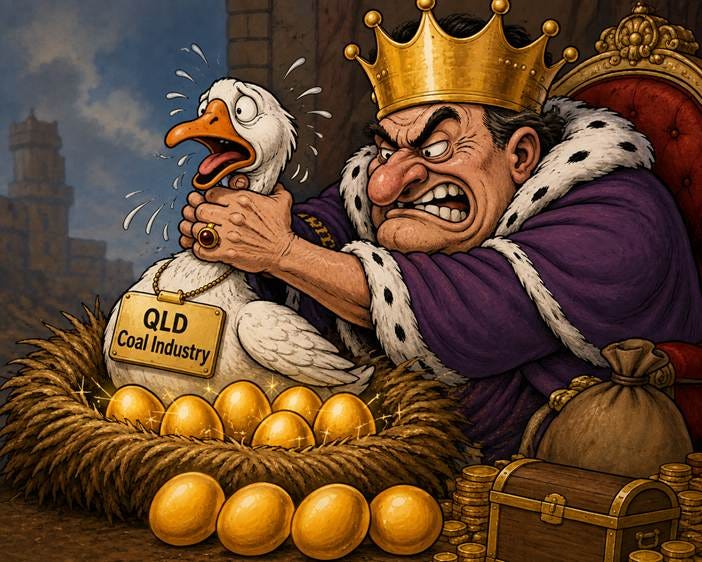
Queensland charges the highest maximum coal royalty rate in the world. The eggs are already counted.
The Ledger
Queensland Treasury reports coal royalties in the revenue chapter of each Budget Paper No. 2. The series below is drawn from the paper that reports each year as a final outcome, with crown export coal volumes from the royalty assumptions appendix of the same papers.
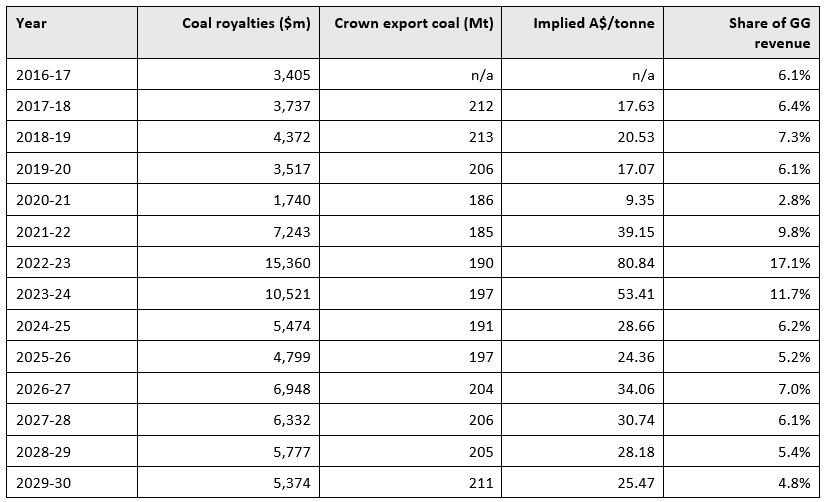
Sources: Queensland Budget Paper No. 2 for 2018-19 (Table 4.5), 2019-20 (Table 4.5), 2020-21 (Table 4.5), 2021-22 (Table 4.5), 2022-23 (Table 4.6), 2023-24 (Tables 4.5 and C.20), 2024-25 (Table 4.5 and Appendix C), 2025-26 (Table 3.4) and 2026-27 (Tables 3.4 and C.1). Revenue denominators from the 2026-27 General Government time series. Crown export coal excludes domestic consumption, being approximately 20 to 25 million tonnes, and coal carrying private rather than Crown royalties, being 4 to 8 million tonnes. [1] [2] [3] [4] [5] [6] [7]
Crown export tonnages moved within a band of 185 to 213 million tonnes across the whole period. Royalty revenue moved from $1,740 million to $15,360 million. The implied rate per tonne ran between A$9.35 and A$20.53 through the six years to 2020-21, then reached A$80.84 in 2022-23. Production explains almost none of that. Price and rate explain all of it.
In 2022-23 coal royalties reached 17.1% of all General Government revenue. One dollar in six of everything Queensland collected came from one commodity. [7]
What the Tiers Delivered
Queensland Treasury has published two attributions for the same policy.
Box 4.7 of the 2023-24 paper, written June 2023, put the uplift from the new progressive tiers at around $7.2 billion over the five years to 2026-27, with around $5.7 billion of that in 2022-23, around $783 million in 2023-24, and an average of around $235 million per year from 2024-25, described as around 6 per cent of total coal royalty revenue once prices normalise. [5]
Box 4.5 of the 2024-25 paper, written twelve months later, put the 2022-23 figure at $5.8 billion and stated that the tiers were expected to deliver a further $3.6 billion in 2023-24. [6]
Treasury’s estimate of the 2023-24 uplift therefore moved from $783 million to $3.6 billion inside one year. The commonly cited $9.4 billion is the sum of the later pair. The earlier pair sums to $6.5 billion.
Treasury also published the counterfactual directly. Without the new tiers, royalties during this period of unprecedented coal prices would have been around one third lower. [5]
Revenue, Not Profit
Queensland levies coal royalty as a percentage of value at the mine gate, rising through tiers to 40% above $300 per tonne. The calculation takes coal sales revenue, subtracts allowable deductions, and applies the rate. Production cost sits outside it. A tonne mined at $80 and a tonne mined at $180 pay the same percentage on the same sale price, in the same period, whether the tonne earns a margin or loses one.
Treasury describes the consequence in its own papers. Lower royalties collected from thermal coal mining reflects the smaller volume mined in Queensland, the lower values per tonne, and the tiered rate system where lower value coal is charged a lower average rate. That sentence appears in the 2019-20 paper describing the old three-tier structure and again in the 2023-24 paper describing the new one. [2] [5]
The producer accounts show the same pattern from the other side. New Hope, weighted toward thermal, paid state royalties of A$13.90 per sales tonne in FY25 across Queensland and New South Wales. [8] Whitehaven, with 64% of revenue from metallurgical coal, shows an implied A$25 per tonne from the gap between an average achieved price of A$215 and an average realised price after royalties of A$190. [9]
Metallurgical coal is also the more volatile commodity. Project economics for a new metallurgical mine rest on high-price years carrying the low ones across a twenty-year life, and a marginal rate of 40% above $300 per tonne removes the top of exactly those years.
Curragh
Coronado Global Resources operates Curragh near Blackwater. Its Form 10-K for the year ended 31 December 2025 sets out what the operation paid and what it earned. [10]
Australian Operations recorded revenues of US$1,185.3 million. Other royalties, being the Queensland state royalty, came to US$126.2 million. The Stanwell rebate, a separate payment under the coal supply agreements with Queensland’s government-owned generator, came to US$100.5 million. Combined, US$226.8 million, or 19.1% of Australian revenue.
Segment adjusted EBITDA for the Australian Operations was a loss of US$157.4 million.
The trend runs longer than one year. Australian segment adjusted EBITDA was US$541.2 million in 2022, US$2.2 million in 2023, US$3.4 million in 2024, then the 2025 loss. [10] [11] Under the previous royalty structure, which topped out at 15% on the balance above A$150 per tonne, Curragh paid US$117.0 million in state royalty in 2021 and US$71.3 million in 2020, with the Stanwell rebate at US$55.4 million and US$103.0 million. [12]
On 27 November 2025 Coronado refinanced its senior secured asset-based revolving credit agreement through a new facility of up to US$265.0 million, being A$406.6 million, with Stanwell Corporation Limited as lender, fully drawn on completion. [10] Stanwell had already provided a prepayment, waived and deferred rebate, and extended the supply term.
Curragh’s strategic importance to Stanwell’s ability to economically generate electricity for Queensland, and to Queensland’s overall energy security, was the primary motivating factor. [10]
A Queensland government-owned generator became the secured lender to a coal miner in order to keep its own fuel supply running. The state extracted from the mine and rescued the mine inside the same twelve months.
BHP Does the Arithmetic
BHP publishes its own calculation. Its results for the half year ended 31 December 2023 state that Queensland remains one of the highest royalty jurisdictions in the world, that the CY22 change increased coal royalties to the highest maximum rate in the world, and that it resulted in an additional US$0.3 billion in royalties paid to the Queensland Government by BHP in relation to that half year alone. Combined with income taxes, the release gives an adjusted effective tax rate including royalties of 62%. [13]
The next paragraph states the consequence. Given the negative impact on investment economics resulting from the change in coal royalty rates, and the increase in sovereign risk due to the decision to raise royalties without consultation, BHP will not be investing in any further growth in Queensland, however it will sustain and optimise existing operations. [13]
Two years later the return arrived. BHP’s FY2025 Annual Report gives the following for its Coal segment. [14]
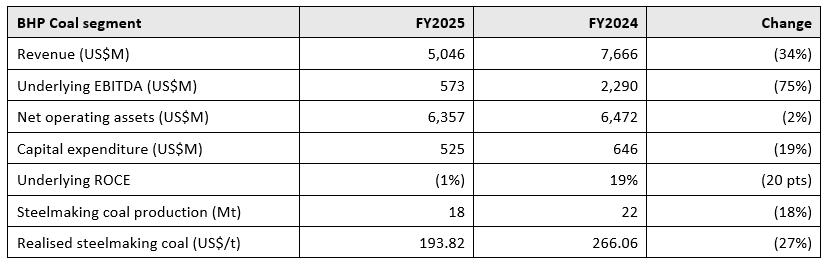
Negative one per cent on US$6.36 billion of net operating assets, in an audited annual report, from the largest producer in the state.
Iron Ore and Coal
The objection to comparing BMA with iron ore is that they are different commodities on different cycles. They are the two inputs to one process. Blast furnace steelmaking consumes both in fixed proportion, from the same country, into the same furnaces, for the same customers. BHP’s own outlook chapters turn on the same drivers for each, being Chinese blast furnace utilisation, Indian pig iron growth and OECD steel demand. [13] [14]
Both prices fell in FY2025 on the same softening. Iron ore realised US$82.13 per tonne against US$101.04, and steelmaking coal realised US$193.82 against US$266.06. [14]
In the half year to December 2023, BHP recorded underlying return on capital employed of 85% at Western Australia Iron Ore and paid an adjusted effective tax rate including royalties of 62% at BMA. [13] Western Australia charges 7.5% ad valorem, unchanged for decades. Queensland charges progressive tiers to 40%, imposed in 2022 without consultation.
Capital followed. In February 2024 BHP approved the Western Ridge Crusher Project at US$943 million on a 100% basis, expected to deliver around 25 million tonnes annually from FY28 at a capital intensity of US$38 per tonne, alongside the Port Debottlenecking Project, the Rail Technology Programme and studies toward 330 million tonnes annually. [13] Queensland received a written statement that no further growth would be funded.
Australia supplies both halves of the steel input. It taxes one at a stable 7.5% and the other at up to 40%.
Two Collapses
Bowen Coking Coal operated the Burton complex near Moranbah and employed around 500 people. On 29 July 2025 the Queensland Revenue Office rejected its submission for a short-term deferral of royalties. On 30 July 2025 the board appointed voluntary administrators, citing higher costs, lower global coal prices and the higher royalty rates introduced by the Queensland Government in 2022. [15]
Vitrinite reached first production at Vulcan in 2022, the year the tiers began. Trafigura, its senior secured creditor, called in receivers on 22 February 2026. Federal Court documents put total debt above $400 million, including $177.3 million owed to Trafigura and $265.9 million in unsecured claims. Vulcan entered care and maintenance on 27 February. Some 348 employees stood down since January are owed more than $16 million in entitlements, and Isaac Regional Council is owed $2.2 million. [16] [17]
Both were single-asset Queensland metallurgical producers. That is the category the structure penalises hardest, and it is the category that failed first.
Three Weeks
On 19 August 2025, three weeks after the Queensland Revenue Office refused Bowen’s application, the Queensland Government announced a royalty arrangement with Bravus Mining and Resources covering the Carmichael mine. [18] [19]
The arrangement originates in an in-principle deferral agreed in 2017, delayed by cabinet infighting, and signed formally in the weeks before the 2020 state election. The deferral was never applied, because the previous government accused Bravus of breaching its terms, a claim the company denied, and both parties entered a confidential Supreme Court proceeding. The 2025 announcement resolved that litigation by honouring the original deal. [19]
Bravus committed $50 million over two years to an expanded workers village, a new water dam, a rail maintenance hub and additional site infrastructure, described by the government as opening the door to a further half billion dollars of investment and 600 new jobs, with production expected to grow from more than 10 million tonnes annually to 16 million. Bravus has paid more than $200 million in royalties since first shipping coal in June 2021. The interest rate and the repayment date remain commercial-in-confidence. [18] [19]
The Premier stated the causal claim directly. Without changing the original deal, the government sent enough certainty that a company would invest, increase the size of the mine and employ 600 extra people. He also stated that no other royalty holidays would be offered to any other mine in the state, and that the government has no plans to change the 2022 arrangements. The announcement coincided with BHP flagging that it may close Queensland mines if conditions remain as they are. [19]
Royalty certainty produces investment. That proposition comes from the Queensland Government, about an arrangement it inherited and declines to extend to anyone else.
Who Sold
BHP refused further Queensland growth investment in 2023 and sold Daunia and Blackwater to Whitehaven in April 2024 for up to US$1.1 billion deferred, plus contingent payments capped at US$900 million. [9] [13]
Anglo American agreed in November 2024 to sell its entire Australian steelmaking coal portfolio to Peabody. Following an ignition in the goaf at Moranbah North on 31 March 2025, Peabody purported to terminate on the basis of a material adverse change, which Anglo disputes and continues to pursue in arbitration. [20] On 18 May 2026 Anglo agreed to sell the same portfolio to Dhilmar Limited for up to US$3.875 billion, comprising US$2.3 billion upfront and a price-linked earnout of up to US$1.575 billion, with completion expected by the first quarter of 2027. The portfolio covers 88.0% of the Moranbah North and Grosvenor joint ventures, 70% of Capcoal, 86.36% of Roper Creek, 51% of Dawson, Dawson South, Dawson South Exploration and Theodore South, and 50% of Moranbah South. [21]
Three of the largest holders of Queensland metallurgical coal have respectively refused to invest, sold the portfolio outright, and walked away from buying it.
Who Bought
Nippon Steel and JFE Steel acquired 20% and 10% of Blackwater from Whitehaven on 31 March 2025 for an aggregate US$1.08 billion. [9]
Yancoal Australia, 62.26% held by Yankuang Energy, itself approximately 52.84% held directly and indirectly by Shandong Energy Group, signed a binding agreement on 14 April 2026 to acquire an 80% interest in the Kestrel Coal Mine in the Bowen Basin for up to US$2.4 billion, being US$1.85 billion upfront and up to US$550 million contingent on benchmark pricing over five years. Kestrel is the largest active underground coal mine in Australia, produced 5.9 million tonnes in 2025, and holds around 25 years of remaining life. Mitsui retains 20%. Completion requires clearance from the ACCC and the Foreign Investment Review Board, and from China’s National Development and Reform Commission, the Department of Commerce of Shandong and the State Administration for Market Regulation. [22] [29]
The sellers are EMR Capital and Adaro Capital, a subsidiary of the Indonesian listed company PT Adaro Andalan. The same joint venture bought the same 80% from Rio Tinto in 2018 for US$2.25 billion. Eight years and one record price boom later, it sold for US$2.4 billion. [29] [30]
Ithaca Resources, an Indonesian mining company, agreed to acquire Vitrinite out of administration for more than $200 million. [17]
Argo Bowen, backed by Talisman Partners and the Swiss commodity trading house Mercuria Energy Group, acquired the Burton complex and associated development projects, having earlier acquired 70% of Fitzroy Australia Resources. Bowen’s mothballed Bluff mine near Blackwater went separately to Maverick M Australia, controlled by UK-registered Meta Mines Investments. [23]
Dhilmar Limited was incorporated in London on 13 November 2024 and is led by Alexander Ramlie, an Indonesian mining executive who also sits on the board of commissioners of Amman Mineral. Its only significant prior asset was the Éléonore gold mine in Quebec, bought from Newmont in 2025 for US$795 million. The financing behind the US$2.3 billion upfront payment has not been disclosed. [21] [24] [25]
Every one of these transactions moved ownership. None added a tonne of production.
What They Bought
The assets transferred at prices set by distress, by insolvency, or by a failed sale following two underground fires. A buyer paying that price acquires the current royalty regime already priced in. Three things came with the purchase, being one certainty and two wagers.
The first is certain and immediate. Private ownership removes the equity market discount applied to coal exposure, the proxy adviser scrutiny of capital allocation, the segment disclosure obligation, and the internal competition against copper that pushed these assets out of BHP and Anglo. The same royalty burden that makes a mine uncompetitive for capital inside a diversified listed major can leave it viable inside a private vehicle funded by trade credit and private debt. [26]
The second is a wager on the royalty. In October 2024 the Mineral Resources Act was amended to introduce a coal royalty rate floor, so that a regulation may prescribe rates no lower than those already prescribed. [10] BHP describes the same amendment as operating in principle to prevent future governments from reversing the current progressive system without parliamentary approval. [14] Reduction now requires an Act of Parliament, which lengthens the odds and leaves the wager live.
The third is a wager on emissions. The Safeguard Mechanism applies a declining baseline that compounds across a mine life, and the assets in question are gassy Bowen Basin longwall operations where abatement is hardest and offset purchase is the practical compliance route. Whitehaven names ACCU price escalation as capable of producing substantially more burdensome compliance costs and flags the scheduled 2026-27 review. [9] Curragh entered a five-year multi-year monitoring period in early 2025, deferring its compliance point. [10] A buyer completing in the first quarter of 2027 acquires the assets with that review outcome either known or imminent.
These are wagers rather than options. An option is a purchased right the holder can exercise. These buyers hold no right to either change and control neither outcome, so what they hold is exposure to two political decisions made by others. What separates it from a pure bet is that they can lobby, and two collapsed miners in Moranbah and Dysart hand them the argument. None of these buyers has said any of this. My reading is that they bought the certain gain and accepted the two wagers alongside it. I could be wrong about that, and the structure sits in the public record either way.
The Counter-Case
Five arguments run against the thesis.
Prices fell across the whole window, and New South Wales raised its own rates on 1 July 2024 from 8.2% to 10.8% for open cut and 7.2% to 9.8% for underground. [13] Compression was general. The answer is that compression was general while capital allocation was directional. New Hope directed its 2025 growth capital to Malabar, exploration licence 9431, West Muswellbrook and Bengalla continuation planning, all in New South Wales, while Queensland received execution capital on an approved mine plan. [8] Yancoal’s 2025 corporate activity was Moolarben, Mount Thorley Warkworth and the Donaldson disposal, all in New South Wales. [22]
Volumes are rising. Treasury projects crown export coal moving from 191 million tonnes in 2024-25 to 211 million tonnes by 2029-30. [7] Whitehaven recorded its best Blackwater quarter since acquisition. [9] Yancoal delivered record attributable saleable production of 38.6 million tonnes. [22] This is correct, and it is why the argument here concerns the 2030s. Development timelines of seven to ten years mean decisions taken now set capacity then.
Assets cleared at real prices. Buyers pricing the royalty into what they pay transfer the burden to the seller as a lower valuation, which moves ownership rather than removing the burden.
Margins remain positive. IEEFA reports June 2025 half-year margins between 11% and 25%, with BMA at 11%, Stanmore at 17%, Glencore’s steelmaking division at 25% and Whitehaven’s Queensland metallurgical assets at 25%. [27] The lowest belongs to the producer that has refused Queensland investment since 2023. The highest belongs to a global division spanning Canada, South Africa and Colombia alongside Australia.
Some Queensland operations expanded. New Acland lifted run-of-mine production from 2.4 million tonnes to 6.3 million tonnes following the January 2025 discontinuance of the Oakey Coal Action Alliance appeal against its Stage 3 water licence. [8] Stage 3 spent more than a decade in the Land Court, the Court of Appeal and the High Court before that point, so the ramp-up completes a fight New Hope began long before the tiers existed rather than an investment chosen under them. Coronado directed more capital to Australia than to the United States in 2025, being US$148.8 million against US$136.6 million, on the Mammoth Underground development. [10] Both are brownfield work on approvals secured before the tiers existed. The claim available from the evidence is that greenfield metallurgical final investment decisions stopped while approved work continued.
The Bill Arrives Later
Queensland Treasury forecasts crown export coal volumes, and the record is one-directional.
The 2024-25 Budget projected 209 million tonnes for 2024-25 against a final 191 million tonnes, 220 for 2025-26 against an estimated actual of 197, 229 for 2026-27 against a budget figure of 204, and 225 for 2027-28 against a projection of 206. Every year overshoots by between 8% and 11%. [6] [7]
The revenue forecasts miss in both directions and at every horizon. The 2024-25 Budget projected 2025-26 coal royalties at $4,810 million against an estimated actual of $4,799 million, accurate to 0.2% two years out, while projecting 2026-27 at $4,595 million against a current budget of $6,948 million. [6] [7] Three consecutive budgets published between 2019 and 2021 projected 2022-23 coal royalties at $3,604 million, $2,761 million and $2,550 million. The outturn was $15,360 million, being undershoots of 326%, 456% and 502%. [2] [3] [4] [7]
Against that record, a decline scenario is a modest proposition. Applied to the 2026-27 crown export figure of 204 million tonnes, a moderate decline of 1.4% annually gives 172 million tonnes by 2035, an accelerated decline of 2.5% gives 152 million tonnes, and a sharp case holding stable to 2027 then declining 4% annually gives 143 million tonnes.
Appendix C of the 2026-27 paper provides the conversion. A one million tonne variation in export volumes changes coal royalty revenue by approximately $33 million, a 1% variation in average export coal price by approximately $143 million, and each one cent movement in the exchange rate by approximately $206 million. [7] On that sensitivity, the moderate case terminal shortfall values at approximately $1.06 billion annually and the sharp case at approximately $2.0 billion.
What Queensland Traded
The producers who held these assets in 2022 published capital allocation frameworks, internal rate of return hurdles, development pipelines and segment economics. Whitehaven discloses a minimum expected post-tax IRR of 15% to 25% on long-term growth projects and names the four projects inside its executive incentive scheme. [9] BHP publishes an adjusted effective tax rate including royalties and government royalties paid and payable of US$2,608 million for FY2025. [13] [14] Coronado publishes Australian segment royalties as a discrete line. [10]
Ithaca, Argo, Dhilmar and Maverick M carry no such obligation. There is no filing that will reveal whether they are investing in mine life or harvesting it, and no segment note that will show Queensland capital additions against depletion.
Queensland has exchanged owners who published their investment intentions for owners who publish nothing. That is the position, whatever those owners eventually do.
Benchmark
A rate cut argued as fairness to operators arrives too late, because most of those operators have sold. Reform now transfers value to the new owners. The case therefore rests on future capacity, and it should be argued that way.
The benchmark uses total government take across all instruments and all levels of government, normalised to a common reference price with jurisdiction-specific cost structures. At a reference price of US$180 per tonne, equal to A$286 per tonne, Queensland metallurgical coal carries a total government take of 40% of export value. West Virginia is 27%. British Columbia is 21%. The Queensland royalty component alone, at A$57 per tonne, exceeds the entire government take in British Columbia. Operating costs run approximately A$110 per tonne in Queensland against A$155 in West Virginia and A$145 in British Columbia, so the penalty applies to the lowest-cost producer of the three. [28]
The same comparison exonerates the rest of the sector. New South Wales and Queensland thermal coal produce essentially identical total government takes at approximately 30% of export value, against Canada at 23%. Western Australian iron ore has carried a stable 7.5% ad valorem royalty for decades, collects more per tonne than Canada, and has attracted continuous capital investment throughout. [28]
Three changes follow.
Restructure Queensland coal royalty to a stable ad valorem rate benchmarked on total government take against West Virginia, British Columbia and New South Wales. Western Australian iron ore is the domestic demonstration that a stable rate sustains investment across a full price cycle.
Publish the deferral criteria, disclose the interest rate applied, and report each arrangement granted. This costs the state nothing against revenue it already forgoes, and it removes the risk premium that every producer without an arrangement currently prices in.
Argue the rate on 2030s capacity, with the arithmetic shown, rather than on the position of operators who have already left.
Coal royalties ran between 2.8% and 7.3% of state revenue across the six years before the tiers, and Treasury projects 4.8% by 2029-30. The 17.1% peak measures how far a single price event carried the budget. The question now concerns what the state collects in 2035, and the decisions that determine it are being taken by owners who file nothing.
References
1. Queensland Treasury, Budget Strategy and Outlook, Budget Paper No. 2, 2018-19, Table 4.5 and Table C.2, June 2018.
2. Queensland Treasury, Budget Strategy and Outlook, Budget Paper No. 2, 2019-20, Table 4.5 and Table C.2, June 2019.
3. Queensland Treasury, Budget Strategy and Outlook, Budget Paper No. 2, 2020-21, Table 4.5 and Table C.2, December 2020.
4. Queensland Treasury, Budget Strategy and Outlook, Budget Paper No. 2, 2021-22, Table 4.5 and Table C.2, June 2021.
5. Queensland Treasury, Budget Strategy and Outlook, Budget Paper No. 2, 2023-24, Table 4.5, Box 4.7 and Table C.20, June 2023.
6. Queensland Treasury, Budget Strategy and Outlook, Budget Paper No. 2, 2024-25, Table 4.5, Box 4.5 and Appendix C, June 2024.
7. Queensland Treasury, Budget Strategy and Outlook, Budget Paper No. 2, 2026-27, Table 3.4, Table C.1 and Appendix C, June 2026.
8. New Hope Corporation Limited, Appendix 4E and Annual Report 2025, year ended 31 July 2025, released 15 September 2025.
9. Whitehaven Coal Limited, Annual Report 2025, year ended 30 June 2025.
10. Coronado Global Resources Inc., Form 10-K for the year ended 31 December 2025, filed with the US Securities and Exchange Commission 3 March 2026, SEC accession 0001562762-26-000024.
11. Coronado Global Resources Inc., Form 10-K for the year ended 31 December 2024, filed 20 February 2025.
12. Coronado Global Resources Inc., Form 10-K for the year ended 31 December 2021, filed 23 February 2022.
13. BHP Group Limited, Financial results for the half year ended 31 December 2023, exchange release, 20 February 2024.
14. BHP Group Limited, Annual Report 2025, year ended 30 June 2025.
15. Bowen Coking Coal Limited, ASX announcement on appointment of voluntary administrators, 30 July 2025, and associated reporting.
16. KordaMentha and Cor Cordis, receivership and administration of the Vitrinite group, appointments 22 February 2026.
17. Industry Queensland, reporting on the Vitrinite receivership and the Ithaca Resources acquisition, 2026.
18. Queensland Government, ‘Investment boost for Central Queensland’s resources sector’, Ministerial Media Statement 103342, 19 August 2025.
19. Mackenzie Scott, ‘Adani Bravus wins royalty holiday in $50m deal with Queensland LNP’, The Australian, 19 August 2025.
20. Anglo American plc, ‘Update on sale of steelmaking coal business to Peabody’, 5 May 2025.
21. Anglo American plc, ‘Anglo American agrees sale of steelmaking coal business for up to US$3.875 billion in cash’, 18 May 2026.
22. Yancoal Australia Ltd, Annual Financial Report for the year ended 31 December 2025, released 25 February 2026.
23. Australian Competition and Consumer Commission, acquisitions register, Argo Bowen 2 Pty Ltd and Bowen Coking Coal Limited, Deed of Company Arrangement Proposal dated 9 February 2026; and Industry Queensland reporting on the Burton and Bluff transactions, 2026.
24. Anthropocene Fixed Income Institute, ‘Australian coal: majors exit, private players in’, 16 June 2026.
25. Yessar Rosendar, ‘Billionaire Alexander Ramlie-Backed Dhilmar To Buy Australian Coking Coal Mines For $3.9 Billion’, Forbes, 18 May 2026.
26. Anthropocene Fixed Income Institute, as above. Note: the Institute is a debt-market research body advocating higher lending standards for fossil fuel assets, and its framing is used here for the disclosure point rather than for its policy position.
27. Institute for Energy Economics and Financial Analysis, ‘Queensland’s coalmines: an open and shut case of royalties versus harsh realities’, September 2025. Note: IEEFA is a renewables-aligned research body; the margin figures are used as published and warrant independent verification.
28. Yancoal Australia Ltd, ‘Yancoal to acquire 80% interest in the Kestrel Coal Mine’, ASX announcement and investor presentation, 14 April 2026.
29. Yessar Rosendar, ‘Indonesian Tycoon Garibaldi Thohir-Backed Adaro Andalan, Partner To Sell Stake In Australian Coal Mine For $2.4 Billion’, Forbes, 15 April 2026.
30. Mark Ostwald, ‘More Beer Please’, 26 March 2026, section 3.4, drawing on IEA Coal 2025, Minerals Council of Australia and EY Royalty and Company Tax Payments Report, Revenue NSW, and the Western Australian Department of Energy, Mines, Industry Regulation and Safety.
Attribution flags
BHP, Whitehaven, New Hope, Coronado, Yancoal and Anglo American are producers with a direct commercial interest in lower royalty rates. Queensland Treasury and the Queensland Government are defending decisions they made. IEEFA and the Anthropocene Fixed Income Institute are research bodies aligned with reduced fossil fuel financing. The Queensland Resources Council is the industry body. Each is cited on the data it publishes rather than on the position it holds, and each flag applies symmetrically.
Method note
Document retrieval, figure verification and drafting assistance by Claude (Anthropic). All budget figures were read from the primary Budget Papers rather than from secondary reporting, and each royalty row is drawn from the paper reporting that year as a final outcome. Company figures were read from the filed annual reports and Form 10-K filings named above. Analysis, argument and conclusions are the author’s.
What’s the likelihood of any change to QLD tax regime occurring? I was royally pissed off as I had the gumption buy a ton of NHC when the price was under $2 a before the Ukraine conflict. And whilst I’ve done OK, my dividends ought to have been a lot higher. Great article