Queenslander!!!
How a state withdraws from the National Electricity Market, and what it gets back

The previous article, “Cost to Serve”, set out what the Electricity Services Entry Mechanism does (ESEM). It moves permanent electricity underwriting off government budgets and into the settlement system, where consumers pay the residual and no parliament votes on the number. Queensland has withheld agreement to it at every stage.
Withholding agreement is worth something. Making it permanent is worth more. This article sets out how Queensland leaves the National Electricity Market, what it costs, what it gains, and why the answer to a centralising national mechanism is a competing state.
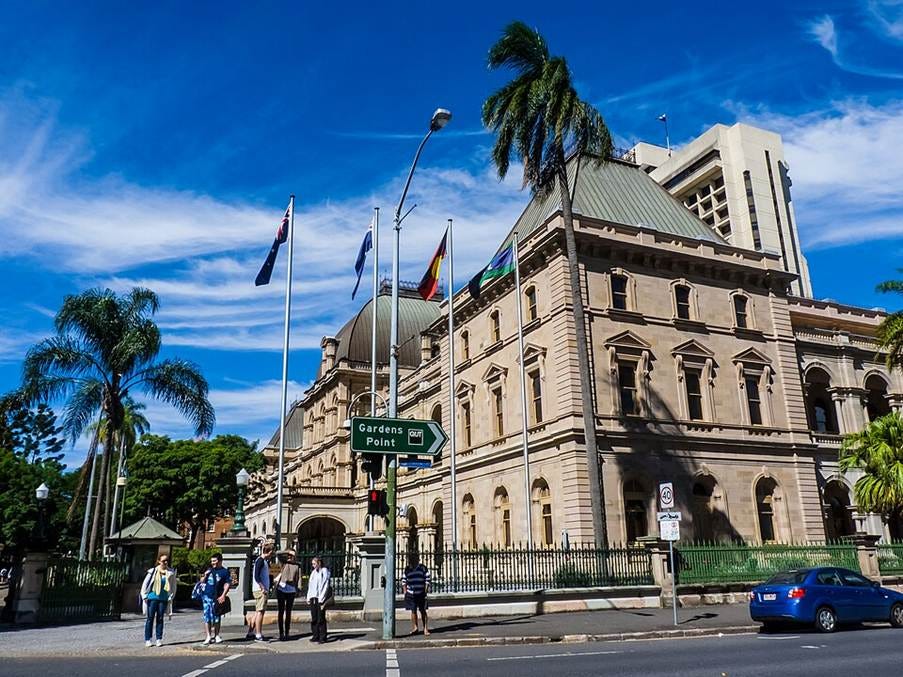
Parliament House, Brisbane. The instrument of withdrawal is a bill of this Parliament.
Photograph by John Robert McPherson, CC BY-SA 4.0, via Wikimedia Commons.
The instrument that binds Queensland
There is a widespread assumption that Queensland’s membership of the National Electricity Market rests on a contract with the Commonwealth. It does not.
The reason there is no single national statute to leave begins with the Constitution. Energy sits nowhere in the heads of power granted to the Commonwealth by section 51, so it remains with the states. The Commonwealth cannot pass a general electricity market law directly. Nine governments wanted one market rather than nine schemes, and the device they reached for to build it is called applied law. One state passes the actual text through its own parliament as the host. Every other state then passes a short Act applying that text as a law of its own. The same words operate in each state by the authority of that state’s own parliament, rather than by any national authority.
Four documents carry the arrangement. The Australian Energy Market Agreement is an intergovernmental agreement between the Commonwealth and every state and territory, dated 30 June 2004 and last amended on 9 December 2013 (Council of Australian Governments 2004). It sets the governance model, establishes the market bodies, and provides the process for amending the national energy laws. It binds governments as a political compact. Courts generally treat instruments of this kind as undertakings between governments rather than as contracts enforceable by a counterparty.
The substantive law, the National Electricity Law, sits in a Schedule to the National Electricity (South Australia) Act 1996 (South Australian Parliament 1996). South Australia is the host jurisdiction, holding the master text for the electricity, gas and retail laws, a role a smaller state with drafting capacity and no dominant market position was well suited to take. The text is agreed among all governments through the Australian Energy Market Agreement and the ministerial council, then lodged in the South Australian statute book. Amendments are made to that Act and take effect in each other state because each state’s application Act adopts the host law as amended from time to time. So a change agreed in a ministerial council and passed in Adelaide takes force in Brisbane without the Queensland Parliament voting again. Queensland consented once, in 1997, to a mechanism that adopts future amendments automatically. The ESEM will enter the law by this route.
The National Electricity Rules are made by the Australian Energy Market Commission under that Law.
Queensland is a participating jurisdiction because the Queensland Parliament passed the Electricity - National Scheme (Queensland) Act 1997 (Queensland Parliament 1997). Section 6 of that Act applies the National Electricity Law as a law of Queensland. Part 2 of the resulting National Electricity (Queensland) Law is headed Participation in the National Electricity Market. Queensland also applies the retail framework through the National Energy Retail Law (Queensland) Act 2014 (Queensland Parliament 2014).
The legal door out is a Queensland statute. Queensland’s Parliament enacted it, and Queensland’s Parliament can amend it or repeal it. Withdrawal rests on Queensland’s own legislative power alone, free of any requirement for Commonwealth consent and beyond the reach of any counterparty seeking to compel Queensland to remain.
Energy Ministers have conceded the principle in writing. The communique of 16 December 2025 records that Ministers agreed in principle to the review’s core recommendations, noting that Queensland provided no in-principle agreement, and recognising the sovereignty of jurisdictions to address the challenges they face (ECMC 2025).
What a refusal is already worth
Queensland has demonstrated the value of dissent inside the current arrangement.
In December 2025, Energy Ministers agreed to release a draft regulatory package for consultation on giving the Australian Energy Market Operator last resort powers in the east coast gas market, noting that Queensland did not support the motion pending further work (ECMC 2025). On 8 May 2026, Ministers agreed to not progress the proposal further (ECMC 2026b). One jurisdiction withheld agreement, and a national measure ended.
Queensland has stated its position plainly to the other governments. In March 2026 it told them it is focused on continuing to support gas and coal generation to maintain broader energy system resilience (EMSG 2026a).
Selective derogation is therefore a live tool, and Queensland is already using it. The case for withdrawal is that derogation preserves the option to say no while leaving Queensland inside a system whose costs, rules and institutions are set by others.
The five steps
Step one. Repeal the application statutes. Queensland amends or repeals the Electricity - National Scheme (Queensland) Act 1997 and the National Energy Retail Law (Queensland) Act 2014, with savings and transitional provisions covering a defined transition period. This is an exercise of Queensland’s ordinary legislative power over an industry that sits within state responsibility.
Step two. Build the replacement framework.
Queensland has two models to choose between, and the choice sets the cost of everything that follows.
The first model keeps a market and runs it under state law. Western Australia is the working example. It operates its own Wholesale Electricity Market, with its own market operator, its own rules, and network economic regulation performed by the state Economic Regulation Authority (AER 2024). Queensland could contract the Australian Energy Market Operator to run a Queensland market under Queensland law, as Western Australia already does, or establish its own operator. This model re-creates the market institutions inside state control, and it suits a system that intends to keep private generation trading at a spot price.
The second model returns to the arrangement that preceded the market. The Queensland Electricity Commission coordinated generation, transmission and bulk supply for the state until the mid 1990s, dispatching a state-owned system as a public utility under a state government department. Electricity sits beneath the economy and underpins it, and this model treats it that way, as an input supplied at cost rather than a commodity traded for profit. It requires three institutions. A system operator to dispatch and maintain security. A pricing authority setting tariffs, accountable to the Queensland Parliament and subject to the Auditor-General. A technical and safety regulator. It carries no wholesale market, and it leaves the state as the coordinator of a system it owns.
The second model costs less to build and less to run, and it is the one this article recommends. Queensland already owns the assets it needs for it. Stanwell, CS Energy and CleanCo hold the generation. Powerlink holds the transmission. Energex and Ergon hold the distribution. The institutional knowledge, the workforce and the balance sheet are in place.
Privately owned generation in Queensland is the complication, and it has two answers. Under a single-buyer model, the state becomes the sole purchaser of electricity, contracting private generators on long-term terms at prices it negotiates, with dispatch directed by the system operator. Under acquisition, the state buys the assets outright. Both are workable. The first is faster and cheaper and leaves private capital in place. The second is cleaner and costs more. The choice belongs to a Queensland government and a Queensland Parliament, which is the argument.
Step three. Keep the physical connection, and use it.
Queensland stays electrically connected to New South Wales through the Queensland to New South Wales Interconnector and the smaller Directlink connection. Those links stay energised. A meter at the border already measures every megawatt hour that crosses, because Queensland exports south today. Withdrawal changes the legal basis on which that power is priced and settled, and it leaves the wires exactly where it is.
This is the opportunity rather than a constraint. Queensland runs a surplus. In the second quarter of 2025, available generation across the National Electricity Market exceeded demand at the evening peak by an average of 6,360 megawatts, and 2,948 megawatts of that surplus sat in Queensland, held back from the southern regions only because the interconnector had reached its system normal limit (AEMO 2025). Queensland already holds firm capacity above its own peak, and it already sends the surplus south whenever the interconnector can carry it. Leaving the market removes none of that. The power keeps flowing across the same wire, metered at the same border, from day one.
Queensland’s grid carries a high proportion of synchronous generation, the large coal and hydro machines whose spinning mass gives the system its inertia and its resistance to frequency disturbance. The southern regions run higher instantaneous shares of inverter-based wind and solar, and South Australia and Victoria have turned to synchronous condensers, retained gas and operator directions to manage the low-inertia conditions that follow. Under interconnection, Queensland’s inertia helps hold the frequency of the whole eastern grid, the southern regions included. Queensland exports stability south along with energy, and it is paid for neither at a rate it sets. A Queensland system operator would keep those machines committed for security rather than dispatch them off for a price, which is a choice a market makes reluctantly and an owner makes deliberately.
Step four. Let the private positions settle themselves.
The financial web across the market is overwhelmingly private. Registrations, hedges and futures reference the Queensland regional price, and they sit between private generators, retailers and traders, rather than with the Queensland Government. Stanwell, CS Energy and CleanCo hold contracts of their own, and those are the state’s to manage through the transition. The rest belongs to parties who chose to take a market position and hedged it.
That makes the transition largely a matter for those parties rather than for the Queensland public. A private generator that sold into the spot market and hedged its exposure made a commercial decision. Under withdrawal it sells to the single buyer, contracts on the terms Queensland offers, or is acquired. The risk sits with the party that took it.
Queensland also keeps an option that the framing of withdrawal tends to hide. Leaving the governance of the market does not require refusing to trade with it. Queensland can stand outside the rules, the ESEM and the ministerial council, and still sell its surplus across the interconnector into the National Electricity Market at the regional price whenever that price is worth taking. Exit from the institution and continued trade with the market are separate choices, and Queensland holds both.
Step five. Settle the Commonwealth and constitutional edges.
Energy sits with the states, so withdrawal needs no Commonwealth permission. The Australian Energy Regulator’s authority in Queensland ends with the applied law that gave it one. Commonwealth funding survives withdrawal, and the record shows it. The Capacity Investment Scheme already operates in Western Australia, which sits outside the National Electricity Market, through tenders run under a bilateral Renewable Energy Transformation Agreement between Western Australia and the Commonwealth (DCCEEW 2026f). What ends with withdrawal is the ESEM, which binds only the jurisdictions that adopt it.
Section 92 of the Constitution requires that trade among the states be absolutely free (Commonwealth of Australia 1900). Queensland proposes to sell south, rather than to restrict what crosses the border, and a vendor setting a price burdens no one’s trade. The state systems that preceded the National Electricity Market traded across borders on this footing for decades, and a Queensland selling south does the same.
Selling to the south
Queensland keeps the physical interconnection and keeps selling its surplus south. The question is the price, and Queensland has two ways to set it.
The first is the price the market already produces. When the southern regions are short, when demand is high and local generation is low, the regional price rises, and it rises in the south before it rises in Queensland because the shortage is theirs. Queensland exports into that high price and is paid it. The scarcity premium is captured at the moment of scarcity, in the price difference across the border, with no negotiation required. When the south needs the power most, the south pays the most, and it pays it now, through the regional price, whenever the interconnector can carry the flow.
The second is a price Queensland negotiates. A bilateral contract trades the price spikes away for a firm number a Treasury can bank, and it holds value when Queensland wants revenue certainty rather than upside, or when Queensland wants to make the political point that it sets its own terms. The negotiated price is the option held in reserve. The market price is the default, because the market price already pays Queensland the most exactly when the south is shortest.
One dependency should be named, because it runs to the heart of both these articles. The regional price rises during a shortage only while the market’s price settings allow it, and the market price cap and the cumulative price threshold are set by the rules Queensland would be leaving the governance of. A Queensland outside the National Electricity Market sells into a price shaped by rules it no longer votes on. That is a reason to name the dependency rather than a reason to stay, and it makes the point that carries the whole argument. Whoever sets the rules sets the outcome.
Section 92 sits comfortably with either price. A government-owned corporation selling electricity to a southern buyer, at the regional price or at a negotiated one, protects no Queensland industry from interstate competition and burdens no one’s trade. It is a vendor setting a price, and section 92 has never required a seller to charge every buyer the same. The design stays on that footing by acting as a vendor rather than as a regulator, and it avoids any Queensland law that would levy, tax or restrict electricity crossing the border. Constitutional counsel should confirm the drafting.
The commercial logic is straightforward. Queensland holds the largest and youngest coal fleet in the National Electricity Market, substantial gas resources, and the Wivenhoe pumped storage. It has been a net exporter to New South Wales in most years. Under the current arrangement, the value of that surplus flows to a five minute dispatch price set under rules that carry no fuel security logic and no regard to who bore the cost of building the plant. Under withdrawal, Queensland decides how it prices the surplus it already sells.
That is what a state owning its own generation is for.
What Queensland gets
Price. A state owned, vertically coordinated system built for lowest delivered cost has no obligation to underwrite technologies chosen elsewhere, no obligation to recover another state’s offshore wind residual, and no obligation to fund an Administrator, a Scheme Financial Vehicle, a co-design process, an industry working group and a reference group. Every source competes on full delivered cost. The state chooses the mix that produces the cheapest reliable megawatt hour at the customer’s meter.
Reliability. Dispatch under Queensland law can be written to include fuel security logic. It can value inertia, system strength and continuous dispatchability as system requirements rather than as afterthoughts procured out of market.
The surplus described in step three is the point here. Queensland holds firm capacity above its own peak, more than the interconnector can carry south, and it supports the southern regions whenever they can take it. The reliability value of imports to Queensland is small. The reliability value of Queensland to the south is large, and under the current arrangement Queensland captures the scarcity value only through a price set by rules it does not control.
Industry. Queensland’s comparative advantage is energy intensive industry. Alumina, aluminium, ammonia, cement, and now data centres and artificial intelligence compute. Each of those depends on abundant firm power at a delivered price the world will accept. Heavy industry locates where firm power is cheap, and it locates nowhere else. A state that controls its own electricity cost structure can bid for that industry. A state inside a national mechanism that sets volume and technology by other states’ emissions targets bids for nothing.
Accountability. What this restores is a coordinating function Queensland ran until the mid 1990s, added to a suite of state-owned enterprises Queensland already operates. A reader hears “leave the national market” as radical and “coordinate the generators the state already owns” as ordinary, and both describe the same act. Queenslanders would elect a government that owns the electricity system, sets its prices, and answers for both at an election. Every element of the cost would appear in a state budget, subject to a Queensland parliament, an auditor general and estimates hearings. The residual would have a line and a name.
What it costs
Withdrawal builds no new power stations. Queensland already holds more generation than its maximum demand, owned through Stanwell, CS Energy, CleanCo, Powerlink, Energex and Ergon. Plant will need replacing over time, and that is true inside the market and outside it. Withdrawal changes none of it. A state in full control of its own system gains something the current arrangement forbids, which is the power to cancel projects that add no value to the whole, state, federal or private, and to keep the capital those projects would have spent.
Queensland recorded the lowest wholesale electricity price in the National Electricity Market in the first quarter of 2026, averaging $65 per megawatt hour, down 27 per cent year on year and the largest reduction of any region, while continuing to back coal and gas generation (AEMO 2026a). Queensland already supplies the cheapest power in the market. The mechanism it is being asked to fund is designed to buy capacity Queensland has not asked for.
The alternative price is a permanent, uncapped, unquantified residual recovered from Queensland households through a settlement process, on contracts designed by a working group with no consumer representative, under terms that live in an administrator’s guidelines rather than in law, with the first settlement arriving around 2032 and the decision being taken in 2026 (Nelson et al. 2025a; Nelson et al. 2025b; DCCEEW 2026d).
Choose the price you can see.
Competitive federalism
The National Electricity Market was built to replace the state based, state owned electricity commissions that preceded it. Those commissions coordinated generation, transmission and distribution within a state, answered to a state government, and were judged by whether the lights stayed on and the price stayed low.
What has grown in their place is a structure in which volume is set by an administrative trajectory, price by a sealed bid auction, technology by other jurisdictions’ emissions targets, and cost recovery by a settlement process, with the parameters residing in guidelines written by an administrator that sets its own risk appetite. Ministers meet three times a year and note things.
The states handed this over, and each did so by statute. The states legislated the National Electricity Law into their own books through application Acts. They signed the Australian Energy Market Agreement. They now exercise what remains of their authority by voting at a ministerial council that meets three times a year and issues communiques. State governments represent the people who elect them, and on electricity those governments transferred the representation upward.
The ESEM is the terminal case. Victoria, South Australia and New South Wales are proposing to transfer contracts entered under their own state schemes into a national administrator, so that liabilities their own parliaments authorised are recovered from consumers through a settlement process those parliaments will never vote on (ECMC 2026b). A state government is arranging for its own commitments to be paid by its own citizens through a national mechanism it will not control. That is abrogation of responsibility.
Federation was designed to let states differ. Differing states produce information. When one state runs a low cost, reliable, publicly owned system and its neighbours run a permanently underwritten one, voters in every state can see which works. That comparison is the mechanism by which federations improve. Harmonisation removes it.
Queensland has abundant coal and gas, the transmission backbone, the government owned generators, the industrial base, and the parliamentary authority to leave. It has already shown that its refusal changes national outcomes. It has said in a Commonwealth document that it intends to keep backing gas and coal generation for system resilience.
Queensland should take the next step. Electricity generated in Queensland, owned by Queenslanders, priced for Queensland households and Queensland industry, with the surplus sold to the south on terms Queensland sets.
The instrument required is a bill in the Queensland Parliament. Everything else is engineering, negotiation and will.
References
Australian Energy Regulator (AER) 2024, State of the energy market 2024, Melbourne.
Australian Energy Market Operator (AEMO) 2025, Quarterly Energy Dynamics Q2 2025, Melbourne, July.
Australian Energy Market Operator (AEMO) 2026a, Quarterly Energy Dynamics Q1 2026, Melbourne, April.
Commonwealth of Australia 1900, Commonwealth of Australia Constitution Act, section 92.
Cole v Whitfield (1988) 165 CLR 360.
Council of Australian Governments 2004, Australian Energy Market Agreement, dated 30 June 2004, as amended 9 December 2013, Canberra.
Department of Climate Change, Energy, the Environment and Water (DCCEEW) 2026a, National Electricity Market Wholesale Market Settings Review (NEM Review) Recommendations - Implementation Pathways, March, Canberra.
DCCEEW 2026d, NEM Review Industry Reference Group, IRG03 meeting presentation, 18 May, Canberra.
DCCEEW 2026f, Capacity Investment Scheme, Canberra. CIS tenders are held in the National Electricity Market and the Western Australian Wholesale Electricity Market, with bilateral Renewable Energy Transformation Agreements negotiated with states and territories.
Energy and Climate Change Ministerial Council (ECMC) 2025, Meeting Communique, 16 December, Canberra.
ECMC 2026b, Meeting Communique, 8 May, Melbourne.
Energy Ministers Sub-Group (EMSG) 2026a, Meeting Communique, 20 March.
McPherson, J.R. 2012, Parliament House, Brisbane, photograph, Wikimedia Commons, licensed CC BY-SA 4.0.
Nelson, T., Conboy, P., Hancock, A. and Hirschhorn, P. 2025a, National Electricity Market wholesale market settings review: Final Report, Department of Climate Change, Energy, the Environment and Water, Canberra, December. Licensed CC BY 4.0.
Nelson, T., Conboy, P., Hancock, A. and Hirschhorn, P. 2025b, NEM Review: Supplementary Materials, Department of Climate Change, Energy, the Environment and Water, Canberra, December. Licensed CC BY 4.0.
Queensland Parliament 1997, Electricity - National Scheme (Queensland) Act 1997 (Qld), Act No. 27 of 1997.
Queensland Parliament 2014, National Energy Retail Law (Queensland) Act 2014 (Qld).
South Australian Parliament 1996, National Electricity (South Australia) Act 1996 (SA), Schedule, National Electricity Law.
Research assistance for this article, including document retrieval and source verification against the primary record, was provided by Claude, an AI assistant developed by Anthropic. All source documents cited above are publicly available. The Nelson review final report and Supplementary Materials are published by the Commonwealth under a Creative Commons Attribution 4.0 International Licence. Analysis, argument and conclusions are the author’s own. The constitutional questions raised in this article require the advice of constitutional counsel.
I hope it comes to pass. :)